


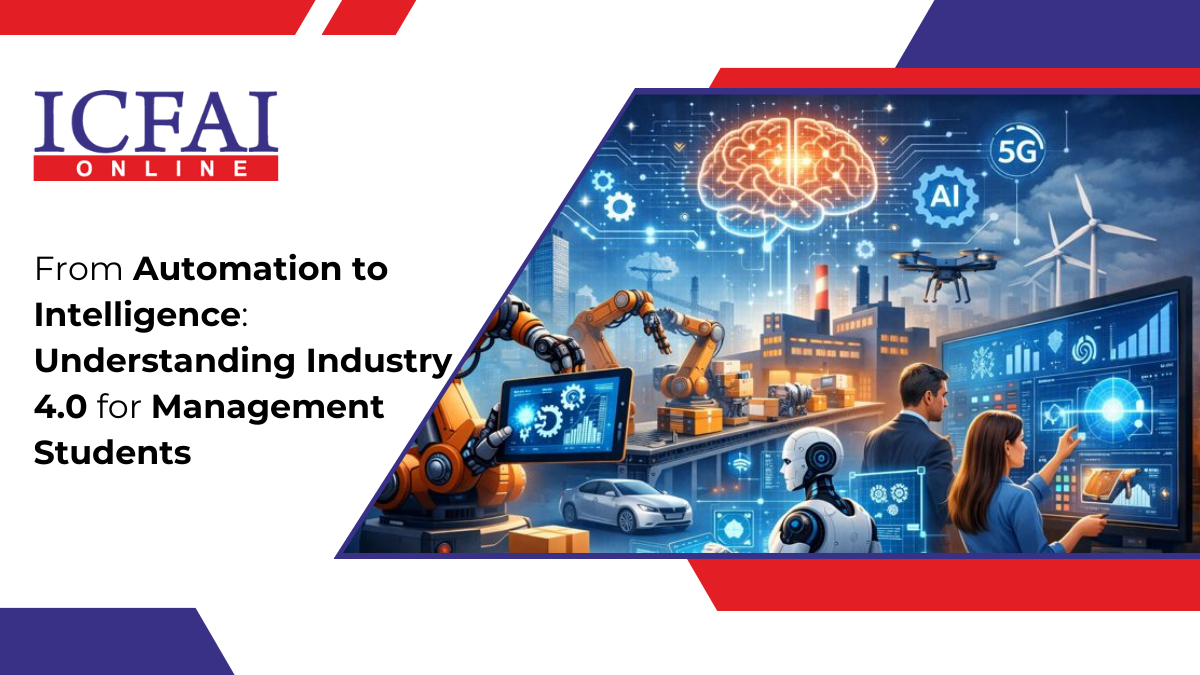
The contemporary business environment is evolving due to the integration of digital technologies. This transformation, known as Industry 4.0, represents a shift from traditional automation to intelligent, interconnected systems. For management students, understanding Industry 4.0 is necessary. Industry 4.0 helps management students by offering them the skills to utilize data, automation, and connectivity to make smart decisions. It also helps in managing processes, and leads digital transformation, foster analytical skills and innovation, impart digital ethics. This prepares the learners for a data-driven, modern business ecosystem with opportunities in new roles and models.
Courses such as those offered by ICFAI Online include subjects like Operations Management, Strategic Management, Business Analytics, and Digital Transformation, which address concepts vital for the 4.0 version of the industrial revolution. It trains learners to connect theoretical concepts with practical business applications.
What is the 4th Industrial Revolution?
Industry 4.0 refers to the fourth industrial revolution. The period follows automation, mechanization, and mass production in the sector. It focuses on integrating digital technologies with real-life business processes to develop systems suitable for active data exchange, analysis, and decision-making. In other words, it refers to the integration of digital technologies into industry and manufacturing practices and processes, thereby optimizing production.
The key technologies driving Industry 4.0 include:
- Artificial Intelligence (AI)
- Big Data and Business Analytics
- Internet of Things (IoT)
- Robotics and Smart Automation
- Cloud Computing
- Cyber-Physical Systems
These technologies help boost efficiency, flexibility, and competitiveness.
From Automation to Intelligence: Industry 4.0 Technologies
Traditional automation relied on structured and repetitive tasks, with less scope for variation and adaptability. Industry 4.0 adapts intelligent systems to process data, predict outcomes, and optimize operations without minimal human engagement.
Examples include:
- Predictive maintenance systems
- AI-based demand forecasting models
- Real-time production planning tools
This evolution enables organizations to make prompt and strategic decisions.

Relevance of Industry 4.0 for Management Students
Industry 4.0 constitutes a technical advancement and a strategic management framework. Understanding the fundamental principles lets learners blend technology with business objectives.
Knowledge of Industry 4.0 helps students:
- Make data-driven decisions
- Understand digital and technology-based business models.
- Introduce innovative organizational change.
- Boost their employability in technology-driven industries.
Programs offered by ICFAI Online incorporate these aspects to prepare learners for managerial roles, where an understanding of such technologies and their use in industry will be an advantage.
Impact on Core Management Functions
The impact of Industry 4.0 on core management functions is given below.
- Operations Management – Smart manufacturing systems improve productivity, quality control, and cost efficiency through automation and analytics.
- Supply Chain Management – Industry 4.0 enables real-time tracking, predictive logistics, and improved coordination across supply networks.
- Human Resource Management – The focus shifts toward digital skills, continuous learning, and effective collaboration between human talent and intelligent systems.
- Marketing and Strategic Management – Big data and AI support customer insights, personalized marketing strategies, and competitive positioning.
Essential Skills for the Industry 4.0 Era
To succeed in an Industry 4.0 environment, management students must develop:
- Analytical and data interpretation skills
- Innovation and change management capabilities
- Strategic thinking with technological awareness
- Ethical and sustainable decision-making perspectives
- Leadership and cross-functional communication skills
Preparing Future-Ready Managers
Industry 4.0 represents a transition from automation to intelligence, reshaping organizational operations and managerial responsibilities. For management students, understanding the concept of Industry 4.0 is essential to becoming visionary leaders.
Through comprehensive programs covering Management, Analytics, Operations, and Digital Strategy, the ICFAI Online programs equip learners with the knowledge and skills required to lead organizations in a digitally intelligent economy. It emphasizes these competencies through industry-relevant and application-oriented curricula.
Frequently Asked Question’s
What is Industry 4.0?
The fourth revolution of industry, or Industry 4.0, means the integration of digital technologies in industrial processes. Technologies such as Internet of Things (IoT), Artificial Intelligence (AI), Cloud and Big Data are being used in the manufacturing process, creating smart factories with interconnected systems and efficient processes. This phase marks the transition from automation to autonomous decision-making.
What are the key technologies in Industry 4.0?
The primary technologies used in Industry 4.0 comprise:
- Internet of Things (IoT)
- Artificial Intelligence (AI) & Machine Learning (ML)
- Big Data Analytics
- Cloud Computing
- Robotics
- Cyber-Physical Systems (CPS)
In management programs, AI & Machine Learning and Big Data Analytics are relevant as they help managers make data-driven decisions in marketing, finance, HR, and strategy. Cloud computing helps in business IT strategy, cost efficiency, and digital transformation.
What is the impact of Industry 4.0 on Management?
The impacts of Industry 4.0 on management are given below:
- Operational Efficiency & Cost: Predictive maintenance, smart energy use, automated quality control, and reduction of waste.
- Decision-Making: Real-time data analysis for strategic and proactive data-driven decisions.
- Market performance: Mass customization, better customer service through the processing of data, and prompt response to the dynamic market.
- New Business Models: Creates opportunities for interconnected products, data-driven services, and personalized customer experiences.







Leave a Reply