


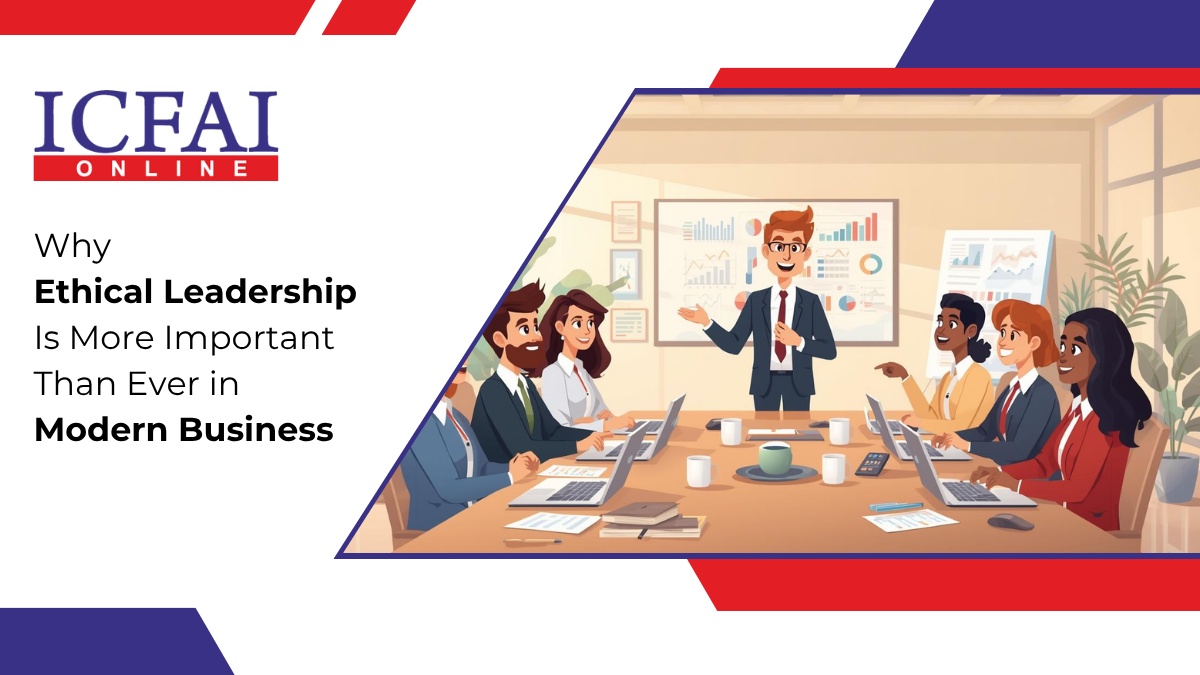
With rapid Innovation, real-time global visibility and requirements of greater transparency, modern business demands more than just managerial skills — it requires ethical judgment. Leaders today must align strategy with integrity to sustain trust and long-term success. For aspiring managers and MBA students, understanding the importance of ethics and integrating it with managerial skills is not just a theoretical lesson — it is a career-defining mindset
What Does Ethical Leadership Really Mean?
Ethical leadership refers to the practice of leading with integrity, a sense of moral responsibility and fairness. It goes beyond compliance or rule-following. It is about leading by example, making decisions that align with both organizational goals and moral values.
Why is it Important:
Ethical leadership:
- Helps in building trust, both internal and external
- Communicates transparency
- Promotes a positive workplace culture
- Helps in enhancing the company’s reputation
What are the traits of an ethical leader:
- Makes fair decisions even under pressure
- Accepts accountability and leads with empathy
- Communicates with transparency & honesty
- Demonstrates a strong sense of personal responsibility
- Upholds moral values
In short, ethical leadership blends business intelligence with human values — a combination that is shaping the future of management.

Why It Matters More in Today’s Business World
1. Business Reputation Is Built on Trust
In a hyper-connected world, customers and investors look beyond products — they look at how companies behave. Ethical leaders strengthen credibility, helping businesses grow sustainably without compromising on integrity.
2. Employees Want Purpose, Not Just Paychecks
Today, professionals prefer organizations that value people over profits. Ethical leadership creates inclusive cultures where talent feels respected, inspired, and motivated to contribute meaningfully.
3. Complex Challenges Need Value-Driven Solutions
From AI ethics to sustainability, modern leaders face gray areas every day. Ethical decision-making provides clarity, ensuring that choices benefit not just shareholders but the society at large.
4. Long-Term Success Over Short-Term Gains
Companies that cut corners may win temporarily, but those built on ethics earn lasting loyalty, stronger partnerships, and consistent growth.
The Ethical Advantage: A Modern MBA Perspective
MBA programs have evolved. They no longer focus only on finance, strategy, or marketing — they integrate ethics and corporate governance across subjects.
At ICFAI Online MBA, for instance, students do not just learn what to decide, but how to decide responsibly. The curriculum blends case studies, simulations, and real-world scenarios, helping learners apply ethical reasoning to complex business challenges.
Through this approach, students develop into leaders who can:
- Build transparent work cultures
- Lead diverse teams with empathy
- Navigate dilemmas with confidence
- Align business strategy with social responsibility
Today’s employers value those leaders who have the ability to combine profitability with purpose, thereby recognizing skills that drive business success as well as have a meaningful impact.
Ethical Leadership in Action:
Take a look at prominent business leaders such as Ratan Tata, Howard Schultz, Satya Nadella, or Indra Nooyi — their leadership stories are rooted in ethics. They are well known for prioritizing integrity and social responsibility while taking decisions. They proved that doing the right thing is not just good for society; it is good for business as well. Their decisions helped build trust, leading to sustainable success.
By learning from such examples, MBA graduates can understand how values-driven leadership can build stronger organizations. Such insights will help them to meaningfully shape their careers.
Final Thoughts
The world does not just need more managers — it needs ethical leaders who can balance ambition with accountability.
In the age of AI, automation, and data-driven decisions, human values remain the ultimate differentiator. Ethical leadership ensures that growth is not only fast but fair — and that success benefits everyone involved.
For students pursuing an Online MBA, especially from institutions like ICFAI Online, developing an ethical mindset isn’t just part of the curriculum — it is the foundation for becoming a trusted, future-ready leader.
Because in modern business, ethics is not an option — it is your edge.
Frequently Asked Question’s
Do I need to be tech-savvy to pursue an Online MBA?
Basic digital literacy helps — knowing how to use video conferencing, learning management systems (LMS), submitting assignments online, etc. But most institutions provide orientation, tech support, tutorials, and helpdesk services to assist students new to online learning.
What are common challenges in doing an Online MBA, and how can I overcome them?
Time management: Balancing work, studies, personal life requires discipline.
Self-motivation: Without physical class schedules, it’s easy to lag — need to set milestones.
Networking limitations: Less face-to-face may limit informal connections; can compensate via online communities, LinkedIn, alumni engagement, etc. Technology issues: Ensure you have reliable internet, good hardware, and backup plan.
How do employers view Online MBA graduates?
Employers value candidates who demonstrate discipline, time management, and self-motivation — qualities developed through online learning. As long as the program is from a credible institution, it is well-recognized and respected in the corporate world.







Leave a Reply