


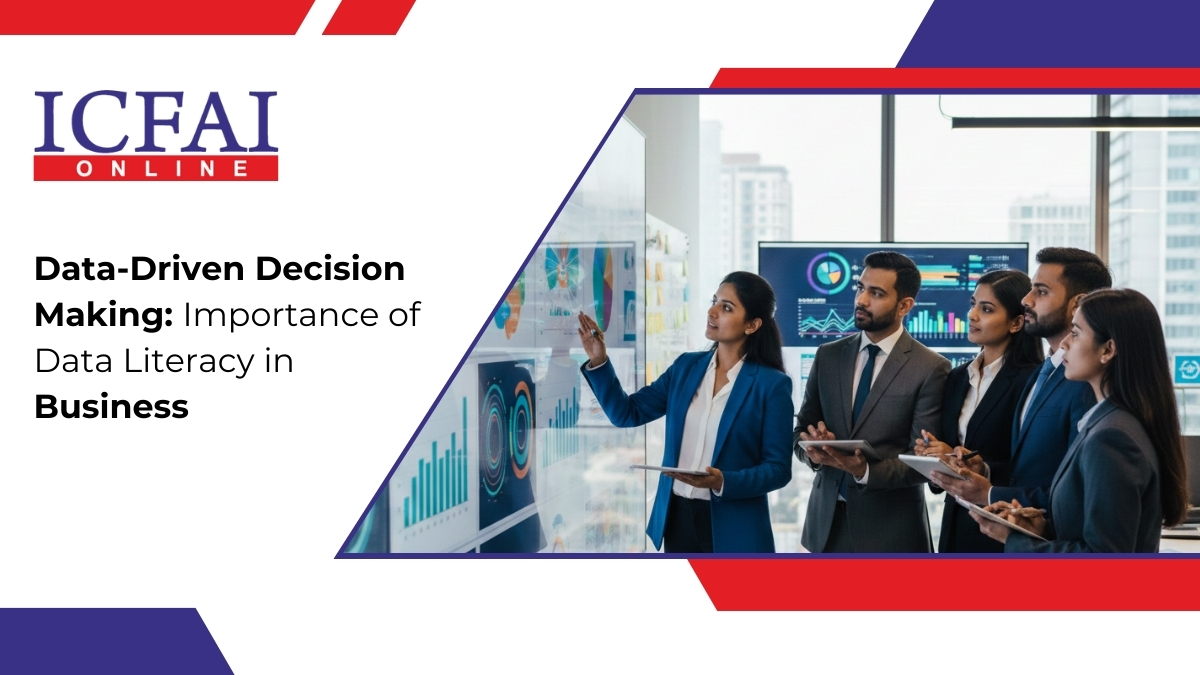
The increasing importance of digital technologies has made data-driven decision-making skills in business strategy critical. Companies generate a huge volume of data, and the information needs to be processed for meaningful business usage. Building these skills lets organizations make strategic decisions, mitigate risks, and stay ahead in the digital landscape.
To address this need, the ICFAI Online programs equip learners and professionals with industry-focused expertise in digital literacy, data analytics, and business decision-making skills through flexible and high-quality education.
What Is Digital Literacy?
Digital literacy refers to the skill of using digital tools and platforms to communicate information effectively. According to the ALA or American Library Association, an individual with digital literacy has the technical and cognitive skills to process information in various formats through different technologies, and use digital spaces to collaborate.
Digital literacy aids in managing information for responsible consumption and usage. It leads the professional to use information from credible sources, create impactful content, and connect people on various platforms.
Why Digital Literacy Is Essential for Business Growth
Digital literacy within the business landscape refers to the ability to optimally use digital tools for organizational efficiency. Businesses must invest in technology and utilize the efforts of the skilled employees & data literacy experts to have a competitive edge in the market.
A joint survey by Microsoft and IDC Asia Pacific found that 75 percent of businesses in Singapore had to focus on digitalization of their operations during the pandemic. These organizations switched to online platforms for operational and business continuity and accelerated the transition of processes.
The report exemplifies how digitalization helps businesses optimize digital tools and platforms to boost quality and productivity of operations. Professionals and workplaces must bridge the digital gaps in their operations and identify the required digital solutions to boost digital literacy.

Types of Digital Literacy
To work in the digital economy, professionals should know the following seven types of digital literacy.
- Information Literacy – It is the ability to find, evaluate, and use information effectively.
- Media Literacy – It involves understanding and critically analyzing media messages, and the creation of media content.
- Technology Literacy – It refers to the ability to use contemporary digital tools and adapt to new technologies.
- Communication Literacy -It ensures that individuals effectively communicate through various platforms.
- Privacy and Security Literacy – It is crucial for protecting personal information and maintaining online security.
- Ethics Literacy – This aspect of digital literacy helps individuals learn the moral and legal implications of digital activity.
- Cultural and Social Literacy – It fosters empathy and understanding of digital spaces.
What are the 4 Cs of Digital Literacy
The 4 Cs of Digital Literacy are given below.
- Critical Thinking
- Communication
- Creativity
- Collaboration
A Practical Framework for Building Data Literacy
Building data literacy requires a systematic approach. Organizations should establish definite objectives, guidance to use analytics tools, invest in continuous learning, and apply data governance practices. Leadership support and institutional learning guidelines play an important role in nurturing data-driven cultures.
Strengthening Data-Driven Capabilities with ICFAI Online Programs
In today’s business environment, digital and data literacy are essential professional competencies. ICFAI Online Programs offer various subjects and electives to train learners in data literacy. Through courses such as Business Analytics, IT for Managers, SMACS Technologies for Business, HR Analytics, and Big Data, Cloud and Analytics, and many others, learners gain the ability to interpret data through digital tools, and apply analytical thinking to practical business challenges.
ICFAI Online Programs provide academically rigorous, industry-oriented online education designed to help learners build expertise in digital technologies, data-driven decision making, and contemporary business practices, enhancing their career prospects.
Frequently Asked Question’s
Why is data literacy important in business?
Data literacy is important in business because it helps professionals process, interpret, and communicate data, make informed and evidence-based decisions. It fosters competitive advantage, boosts operational efficiency, drives innovation, and enhances customer experience.
What is data-driven decision-making?
Data-driven decision-making is the process of utilizing verified data to guide business decisions. It involves collecting, assessing, and interpreting data to reveal patterns and insights to optimize performance, mitigate risks, and align with organizational goals.
What are the key benefits of a data-driven approach?
The key benefits of a data-driven approach include:
✅Improved decision-making by reducing bias and the risk of error.
✅Increased efficiency and reduced costs by optimizing operations and managing resources.
✅Enhanced customer understanding through gaining deeper insights into customer behavior, facilitating personalized experiences, and better acquisition rates.
✅Proactive problem-solving through real-time data facilitates early detection of issues, like equipment failures or market shifts.
✅Competitive advantage through identifying new market trends and opportunities.
✅Enhanced collaboration and transparency through fact-based insights for effective team communication and aligned organizational goals.






Leave a Reply