


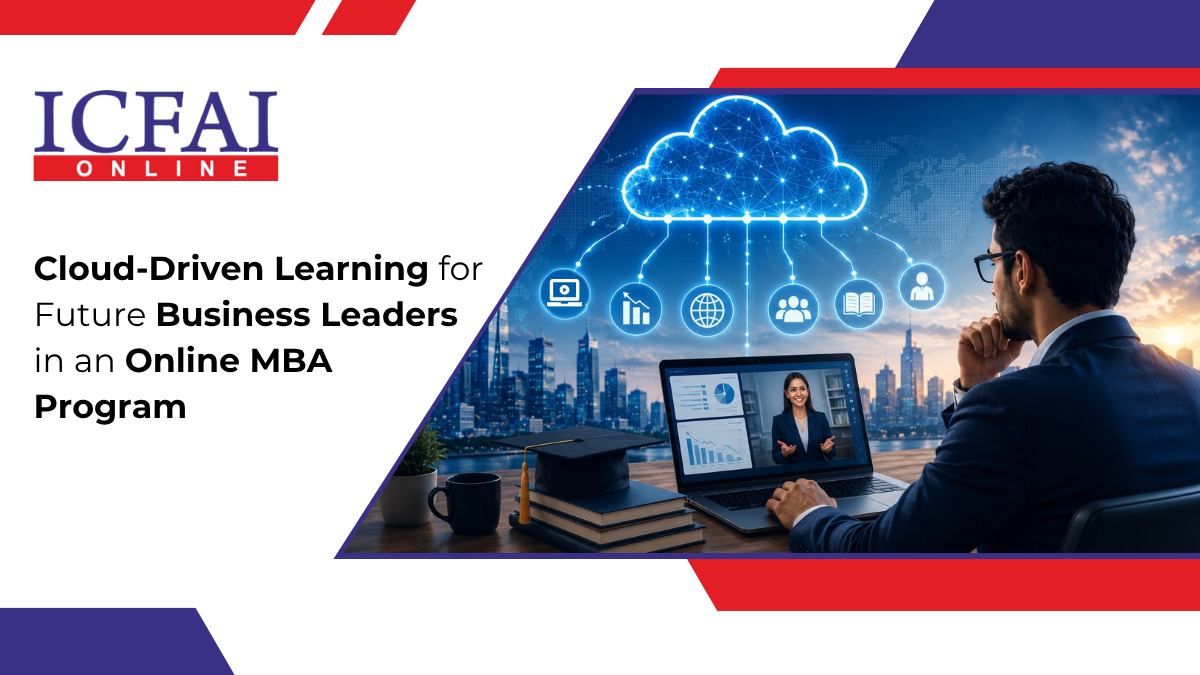
- Cloud-driven learning is transforming how business education is delivered and experienced.
- Learners today are interacting with practical digital tools used in modern companies.
- Cloud technology brings flexibility and enables experiential learning.
- Employers expect professionals to adapt to digital-first work environments.
- The ICFAI Online MBA program blends management learning with cloud-based education.
How Cloud Technology is Reshaping Business Education in an Online MBA
Cloud technology has transformed the way work is executed, how we communicate, and how we pursue learning. Instead of depending on old methods of software or file storage on a single computer, cloud-based platforms make it accessible online through secure, interconnected data centers. Whether an individual is using a laptop at home, a tablet while travelling, or a smartphone during their commute, the learning resources are always a tap away.
This shift has been impactful on Online MBA programs. Learning is no longer limited to the confines of the classroom or fixed schedules. Learners can participate in live lectures, revisit recorded sessions, access study materials, and submit assignments digitally. For working professionals managing careers, personal commitments, and education simultaneously, this flexibility makes pursuing an Online MBA viable.
This digital-first approach is seen across many modern online learning platforms, such as the programs offered by ICFAI Online. By leveraging cloud-enabled learning environments, learners gain access to academic resources, virtual classrooms, assessments, and tools designed to support learning from anywhere. These cloud-based systems improve scalability and accessibility while reducing the cost and need for extensive physical infrastructure.

Learning Experience in a Cloud-Based Online MBA
Cloud-enabled Online MBA programs offer a learning environment that is continuous, interactive, and application-oriented. Individuals can access learning resources at their convenience, collaborate with peers and faculty through digital platforms, and engage with practical business scenarios through case studies and simulations. This flexible and practical approach helps learners relate academic concepts to the challenges of the modern business environment.
Students can participate in the program through case-based learning and business simulations. This approach helps learners in experiential learning. In addition, learners develop essential skills such as analytical thinking, digital communication, data interpretation, and working in virtual teams.
Career Outcomes and Workplace Readiness
Cloud-enabled Online MBA programs prepare learners for the workplace. Since modern organizations operate in digitalized environments, students are trained in similar conditions during their studies. Subjects like marketing, finance, HR, and operations are offered through digital tools and practical scenarios.
This ensures learners become familiar with the following practices.
- Data-driven decision-making
- Cross-functional collaboration in virtual environments
- Digital workflows and tools
This supports a smooth transition from education to employment, and graduates are aligned with industry expectations.
The management graduates often pursue roles such as:
- Business Analyst
- Marketing Manager
- Sales executive/ Manager
- Operations Executive
- HR Manager
- Product Manager
- Project Coordinator
- Digital Transformation Specialist.
Cloud Service Models Supporting Online MBA
Cloud computing is built on four primary service models that support modern Online MBA platforms.
The platforms include the following.
- Software as a Service (SaaS) offers ready-to-use applications delivered through the internet without installing them.
- Platform as a Service (PaaS) offers cloud environments for building, testing, and implementing applications.
- Infrastructure as a Service (IaaS) delivers virtual servers, storage, and computing resources on demand.
- Function as a Service (FaaS) facilitates event-driven code execution without managing servers.
Building Future-Ready Leaders with ICFAI Online MBA
Modern business leadership endorse adaptability, analytical thinking, and digital expertise. Cloud technology supports these competencies by integrating real-world tools, data systems, and collaborative environments into the learning process. An Online MBA becomes more than an academic program; it becomes a structured pathway for workplace readiness.
The ICFAI Online MBA program supports this transformation through the blend of management expertise with cloud-driven learning experiences that reflect the practices in today’s business world.
As industries adopt cloud technologies, the gap between learning and working is shrinking. This creates professionals who are confident, capable, and prepared for digital-first careers.
Frequently Asked Question’s
1. What is cloud-based learning in an Online MBA program?
In an Online MBA program, cloud-based learning implies accessing study materials, lectures, and assignments through the internet. In this activity, remote servers facilitate the services rather than installing software. The learners can study and collaborate from anywhere, on any device, by logging in. The primary components include the following.
- Learning Management Systems (LMS)
- Live virtual classrooms
- Collaborative tools such as Google Workspace and Microsoft 365
2. Does a cloud-based Online MBA require a background in software engineering or IT?
No, a background in software engineering or IT is not required for an online MBA program. Most programs accept graduates from any discipline and offer essential knowledge and skills in business, leadership, and analytical skills. The curriculum of an Online MBA program focuses on universal business functions. The primary eligibility criteria are standardized and require applicants to hold a bachelor’s degree from an accredited institution and meet the minimum academic marks.
3. How do cloud-enabled business schools align graduates with corporate expectations?
Cloud-enabled business schools align graduates with corporate expectations by combining technical expertise with strategic management. They replace theoretical IT frameworks with experiential, platform-specific training and enterprise-oriented methodologies, ensuring graduates know how to apply technical skills to boost core business value and scalability.
4. What practical digital tools do students use for experiential learning in the cloud?
In an Online MBA program, learners can access cloud-based experiential learning through virtual IT and coding environments, immersive VR/AR simulations, specialized placement software, and generative AI sandboxes. These platforms let learners practice real-world skills, test applications, and collaborate remotely without the requirement of physical equipment.





Leave a Reply