


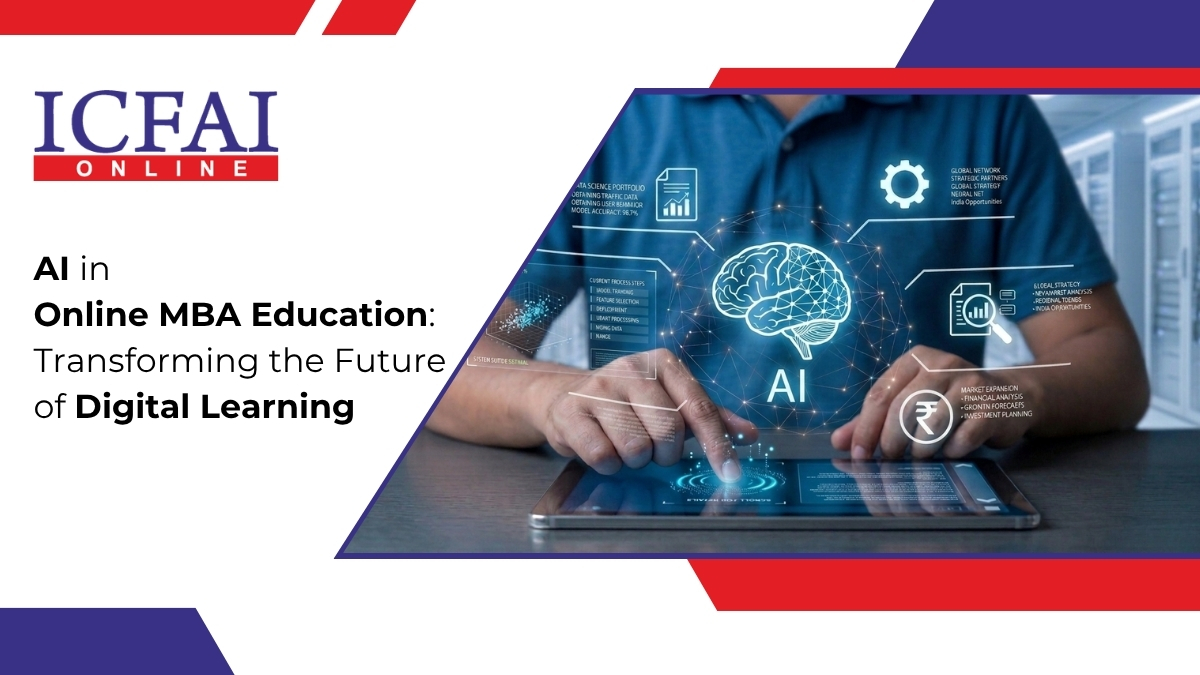
- Leveraging AI creates a customized academic journey for each learner.
- Real-time feedback helps learners improve as they pursue their degree.
- Interactive simulations develop practical skills in business decision-making.
- Flexible digital learning helps professionals balance work-life-study schedules.
- AI ensures an industry-oriented and modern MBA curriculum.
Reimagining Online MBA Learning with AI-Powered Digital Platforms
The increasing popularity of AI in Online MBA education is influencing the curriculum as well as how it is being offered to learners. Conventional classroom-style delivery is being replaced by adaptive and interactive digital ecosystems. For modern professionals, this shift is about creating a learning journey that fits their schedule.
In the ICFAI Online program, this is reflected in a smart learning environment where learners are guided by data-oriented systems. Participants can access study material, and learners interact with platforms that understand their progress, highlight gaps, and recommend next steps. This makes the program an innovative and guided experience tailored to each learner’s journey.

Individualized Learning Experience in Online MBA Programs
Some Online MBA programs offer AI-based personalized education. Each learner has their own pace, comprehension level, and professional goal. AI systems analyze the patterns and develop personalized learning paths that adjust in real time.
This ensures that no learner faces any issues while pursuing their MBA education. Learners receive additional practice material, targeted recommendations, and instant feedback based on their performance. For professionals pursuing an online MBA degree, this flexibility lets to balance education with personal and professional commitments.
AI Tools Aiding Modern MBA Learning Platforms
The growth of Online MBA learning platforms has introduced various AI-powered tools that enhance how learners study and apply those skills. The AI-powered tools are given below.
- Intelligent dashboards to monitor progress and apply learning insights
- Virtual assistants to offer prompt support and resolve queries
- Predictive analytics tools to simplify business concepts and forecast results
- Simulation-based platforms to replicate real-world business environments
- Strategy testing to experiment with varied approaches
- Outcome analysis to understand results and improve performance
- Risk-free decision-making practice through virtual scenarios
Benefits of an AI-Enhanced Online MBA Program
The benefits of an AI-integrated online MBA program are given below.
- AI-oriented Online MBA develops future-ready skills beyond conventional pedagogy.
- Learners gain expertise in business analytics, digital transformation, and strategic thinking.
- These skills are invaluable in the modern job market.
- AI customizes learning by identifying strengths and improvement areas.
- Flexible learning lets Professionals upskill without a career pause.
Is an MBA Still Relevant in the Age of AI?
With the rise of automation and intelligent systems, there is doubt whether MBA education still has value. An AI-integrated Online MBA program is not replacing traditional MBA expertise; it is enriching the education to be more impactful and relevant.
While AI processes and automates data, human skills such as communication, strategic thinking, and leadership capabilities are irreplaceable. The modern MBA addresses this gap by combining business expertise with technological competencies. The modern Online MBA programs reflect this balance and prepare learners for leadership roles in AI-oriented business environments.
The Future of Business Education with AI
The integration of AI into digital learning platforms is reshaping online MBA studies, making it more engaging, tailored, and outcome-oriented. Learning extends beyond textbooks. It has become interactive, adaptive, and aligned with practical business needs.
This transition is shaping a new age of professionals who are possess business and technology knowledge, and have strategic decision making competencies. The MBA from ICFAI Online continues to lead this shift by offering a program that combines innovation, flexibility, and industry relevance. For learners wanting to build strong, future-proof careers, it represents a strategic and forward-looking option.
Frequently Asked Question’s
How is AI transforming the Online MBA education?
AI is transforming Online MBA education by transitioning from a static, content-based model to a personalized and data-driven experience. In the present times, AI is treated as a primary component of the curriculum, embedding AI, data analytics, and machine learning into conventional subjects like marketing, finance, and strategy.
Will AI replace the need for an Online MBA education?
No, AI will not entirely replace Online MBA education, but redefine and enrich it. While AI can automate analytical and data-driven tasks, it cannot replicate human judgment, leadership abilities, empathy, and strategic thinking skills that are essential to a high-quality Online MBA program.
What AI-driven skills are taught in 2026 Online MBAs?
The top AI-driven skills that are taught in 2026 Online MBA programs are given below
- Prompt Engineering & AI Collaboration
- AI-Powered Data Analysis
- No-Code AI Automation & Agent Building
- Strategic AI Integration
- Generative AI in Marketing/Content
- Ethical AI & Risk Management
- Python & Analytical Modeling
Which specializations are relevant in an AI-driven future?
The specializations that are relevant for an AI-based corporate system are given below.
- Business Analytics
- Artificial Intelligence
- Big Data, Cloud, and Analytics
- IT for Managers
- Digital Marketing
- Operations Management
- Supply Chain Management
- HR Analytics
- Business Policy and Strategy
- Leadership and Change Management
What are the ethical considerations of AI in Online MBA education?
Ethical consideration of AI in Online MBA education focuses on algorithmic fairness, data privacy, and transparency to prevent bias in selection or grading. Some primary issues include avoiding automation bias by including human oversight, ensuring fair access to tools, protecting data, and encouraging academic integrity, often termed as responsible AI or trusted AI.






Leave a Reply